Why Bragging About AI Might Be Costing You Customers
Bragging about your tech might boost your ego - but does it actually earn your customer’s trust?
AI is everywhere.
It’s in pitch decks, ad copy, keynote slides - sold as the magic behind smarter products and faster results.
But the hype has a flipside.
Because while AI promises efficiency and scale, it has also produced some of the most public, expensive, and embarrassing failures in recent memory.
Lawyers fined for filing fake court citations generated by ChatGPT.
A startup billed as the “robot lawyer” sued and penalized by the FTC for misleading its customers.
IBM’s Watson for Oncology - once heralded as the future of cancer care - pulled after giving unsafe treatment recommendations and wasting over $60 million.
Apple’s credit card AI sparked outrage when women received significantly lower credit limits than their spouses.
And in the UK, an exam-grading algorithm downgraded 39% of student scores, disproportionately hurting those from disadvantaged schools - triggering national protests and a complete government U-turn.
These are just a handful of cases. There are dozens more.
What they share is not the presence of AI, but the absence of oversight, judgment, and customer empathy.
So before you brag about using AI, ask yourself:
Are you building confidence - or raising red flags?
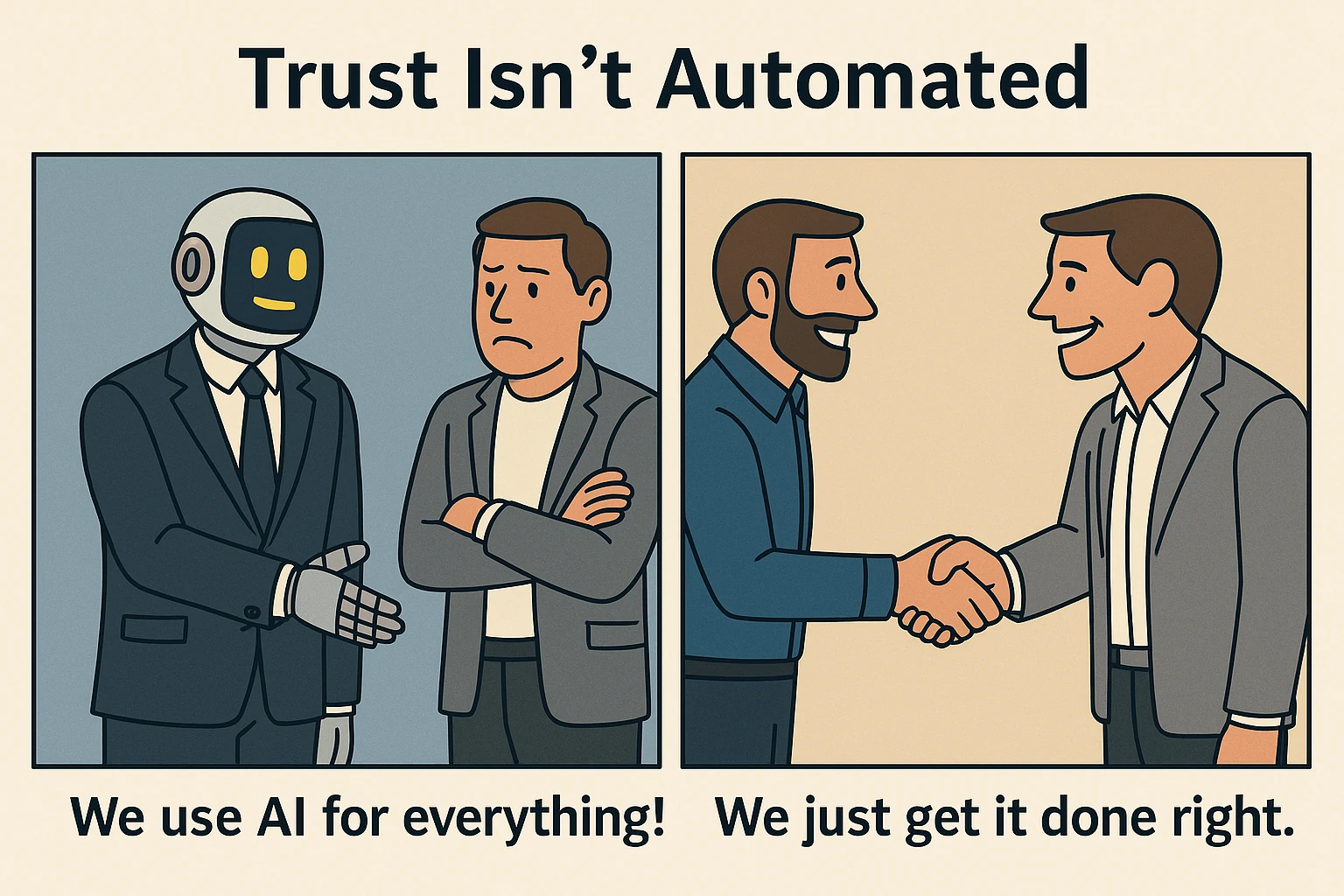
What customers actually hear when you say “AI”
You might think “AI-powered” sounds innovative.
But to many customers, it sparks silent questions:
- “Will I get a generic response?”
- “Is anyone actually paying attention to me?”
- “If something goes wrong, will I be stuck talking to a bot?”
For some, it suggests less care. Less accountability. Less human touch.
Even those who aren’t actively worried may feel nothing at all.
The phrase “AI-powered” has become background noise - a buzzword that raises questions instead of answers.
The truth is simple:
Most customers don’t care how you get the job done.
They care that you do it well, on time, and with their interests in mind.
If AI helps you do that - great.
But the moment it becomes the centerpiece of your pitch, you risk shifting focus from value to tools.
And that’s a shift most people never asked for.
When AI talk works - and when it doesn’t
Let’s be clear: AI isn’t the enemy.
It’s a powerful tool. In the right context, mentioning it can build confidence.
But context is everything.
If your audience is made up of engineers, early adopters, or procurement teams comparing feature sets - “AI-powered” might signal capability.
If you’re speaking to a small business owner, a parent hiring a tutor, or a patient choosing a clinic - it might signal the opposite.
Tech-forward buyers might lean in.
Trust-first buyers might lean back.
The key question isn’t “Do we use AI?”
It’s “Does saying we use AI make this person feel more confident - or more concerned?”
If you’re not sure, that’s your answer.
Shift the focus: from tools to outcomes
Customers don’t buy your process. They buy your promise.
They want a clean house, not a lesson in vacuum engineering.
They want a solved problem, not a peek at your backend stack.
They want the dish to taste great - they don’t care if you used AI in the kitchen.
The point of AI is to help you deliver better, faster, more reliably.
That’s worth doing. But it’s not always worth mentioning.
Unless your use of AI directly improves the customer’s outcome in a way they can feel - clarity, speed, personalization, price - let it do the work silently, behind the scenes.
Don’t lead with what’s under the hood.
Lead with what shows up on the plate.
Ask before you shout
Before you put “AI-powered” front and center, pause.
Ask yourself:
- Does this build trust - or introduce doubt?
- Is this solving a customer problem - or stroking our ego?
- Would this person feel more confident not knowing how the work gets done?
If the answer isn’t clear, the benefit probably isn’t either.
Use AI where it makes you better.
Talk about it when it makes them feel better.
Because your tech stack shouldn’t be a distraction.
It should be invisible - working in service of outcomes your customer actually cares about.
Conclusion: trust is the real product
It’s tempting to lead with the shiny stuff.
To say, “Look - we use AI!”
But most customers don’t care how advanced your tools are.
They care if you listen.
They care if you follow through.
They care if what you deliver works.
“AI-powered” might win points in a tech demo.
But in the real world, trust, quality, and clarity win the deal.
So unless your use of AI makes the result tangibly better for the customer, leave it in the kitchen.
Serve the dish. Make it great. Let them come back for seconds - not the recipe.