Stop Losing Readers - Start Writing Stronger Subheadlines
Your headline hooks them - your subheadline keeps them.
Let’s face it, your reader is skeptical. Honestly, so am I - and chances are, you feel the same. It’s not negativity - it’s instinct. So when a headline makes a bold promise, a flicker of doubt is almost guaranteed to follow.
And that flicker? It’s not just a passing feeling. It’s a silent, split-second judgment that determines whether you get to keep their attention.
The silent objection: What happens right after the headline
After a bold headline earns a few milliseconds of focus, a quiet but critical question immediately pops into your reader's mind. It's less a full thought and more a gut reaction that sounds something like this:
- "Oh, really?"
- "How, exactly?"
- "Prove it."
That internal monologue has a name: the Silent Objection. It's the moment a reader's brain instinctively seeks proof or clarification for the claim you just made. They don't shout it, they don't comment on it, and they certainly don't email you about it.
They just leave.
That exit is a "no" vote. It’s a complete abandonment. It’s the user deciding, “Nope, not worth my time to find out.” This is the exact moment where your entire pitch is won or lost, and it happens long before they ever see your features list or call to action.
So if the headline is our opening line, we have to be ready to disarm that silent objection right away. But how?
Why the subheadline is your first line of defense
You answer it with the subheadline.
That single line of text is not decoration; it's your designated first responder. Its sole job is to address that flicker of doubt before it solidifies into a decision to leave.
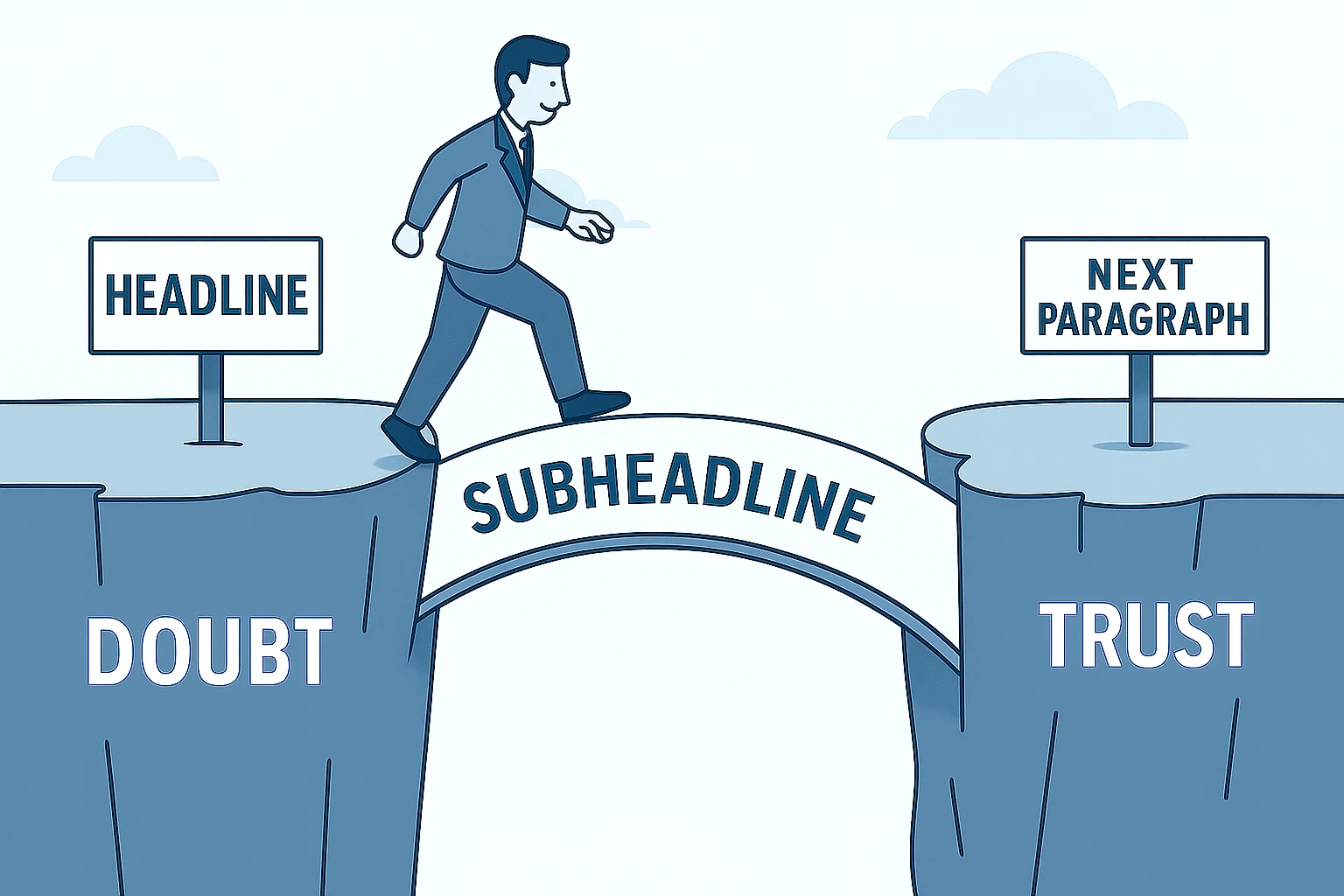
Think of it as a direct and immediate transaction. The headline makes a promise. The subheadline starts proving that the promise is credible. It's the instant your words pivot from grabbing attention to earning trust.
It's the plank on the bridge spanning the gap between "I'm interested" and "I'm listening." It doesn’t need to get the reader all the way across - your body copy will do that. It just needs to be solid enough to convince them it's safe to take that first step.
In short, it's what turns their skeptical "Prove it" into a curious, "Okay, show me."
What a good supportive subheadline actually does
Moving a reader from skepticism to curiosity isn't magic. It’s mechanics. A strong subheadline performs three specific jobs with brutal efficiency:
- It clarifies the promise. A headline has to be broad and punchy. The subheadline zooms in to add specifics. It grounds a big claim like "Revolutionize Your Workflow" with a concrete function, such as "A simple tool that automates your team's most repetitive tasks."
- It anchors emotion with logic. Great headlines often tap into an emotional desire (less stress, more success). This can trigger a "too good to be true" alarm. The subheadline provides immediate, logical reassurance. It backs up "Finally, Get a Good Night's Sleep" with a plausible mechanism like, "Our guide explains the 5 habit changes that reset your natural sleep cycle."
- It signals what's next. A subheadline manages expectations by telling the reader what kind of content they're about to receive. It reduces uncertainty and makes the "ask" feel smaller and safer. For example, it turns the intimidating "Master Public Speaking" into a manageable, "A 10-part video series breaking down speechwriting for nervous presenters."
Think of it as a simple, silent formula:
Big Claim -> Specific Answer -> Clear Path Forward
This isn't just about sounding better. It's about building enough trust to get your first paragraph read.
Seeing it in action: weak vs. strong subheadlines
Theory is one thing, but the difference between a subheadline that works and one that wastes space becomes painfully obvious when you see them side-by-side.
A weak subheadline is usually vague, repeats the headline's idea, or is filled with empty marketing jargon. A strong subheadline gets to work immediately.
Let's look at a few examples.
Example 1: The Blog Post
Headline: The Procrastination Paradox
Weak Subheadline: Learn how to finally stop putting things off and get more done. (This is predictable. It's what the reader already expects, so it adds no new information and builds zero trust.)
Strong Subheadline: New research reveals how intentional delay can actually boost creativity and focus. Here’s the simple method to use it to your advantage. (This one is powerful. It clarifies the surprising angle of the paradox, anchors it with the logic of "new research," and signals that a specific "simple method" is coming.)
Example 2: The Landing Page (for a SaaS product)
Headline: Meet Synapse: The End of Messy Team Projects
Weak Subheadline: The future of collaboration is here. (This is pure fluff. "Future of collaboration" means nothing, triggers the hype alarm, and answers zero questions.)
Strong Subheadline: Our AI dashboard plugs into Slack and Asana to instantly track goals, summarize decisions, and flag overdue tasks before they become problems. (This is a perfect response to the "How?" objection. It specifies exactly what the tool does and what platforms it works with, making the big promise of the headline feel tangible and credible.)
Example 3: The Product Description (E-commerce)
Headline: The Nomad Carry-On
Weak Subheadline: A suitcase designed for the modern traveler. (This is a cliché. It feels like placeholder text and does nothing to set the product apart from a thousand other suitcases.)
Strong Subheadline: Our shatter-resistant polycarbonate shell weighs just 7.1 lbs and glides on silent, 360-degree spinner wheels to make airport dashes effortless. (This is it. It combines specific, trustworthy details ("shatter-resistant," "7.1 lbs," "360-degree spinner wheels") with a benefit that solves a well-known pain point - the noisy, clumsy drag through a crowded airport. It answers silent questions about durability, weight, and ease-of-use without creating any new doubts.)
How to write your own: A simple, doubt-busting process
So, you can now spot a great subheadline in the wild. But how do you write one yourself?
Fortunately, you don’t need a special brand of magic. You just need a repeatable process. When you're staring at your headline, feeling good about its punch, here’s how to craft the subheadline that ensures it lands.
It’s a simple, three-step mental exercise.
- Read your headline and identify the doubt. Read it out loud. Now, put on your skeptic’s hat. What is the most obvious, gut-level question it provokes? Is the claim too big? Be honest with yourself about the silent objection. ("Revolutionize Your Workflow" -> Doubt: "How? Sounds like jargon and more work for me.")
- Draft a direct, specific answer. Your only goal is to answer the doubt from the reader's perspective. Don’t try to be clever or sell. Be concrete. ("How?" -> Answer: "By automatically pulling data from your tools to build your weekly reports.")
- Refine for clarity. Now, polish that answer into a single, clear sentence that flows from the headline. Cut any unnecessary words and focus on the benefit to the reader. ("It connects to the tools you already use and automatically generates your team's weekly reports.")
That’s it. That’s the entire process.
A Pro tip to guide your thinking (not just your words)
If you're stuck, use the following phrases as a mental prompt to force yourself to answer the reader's doubt. They are scaffolding, not necessarily the final words.
For example, faced with the headline "Learn a New Language in 15 Minutes a Day," you'd identify the doubt: "Really? How is that possible?"
- Start with the prompt: "Here's how..."
- Complete the thought: "...our AI tutor breaks grammar into tiny, personalized micro-lessons."
- Refine by removing the scaffold: "Our AI tutor breaks grammar into tiny, personalized micro-lessons you can finish on your lunch break."
See how the final version is stronger? It's direct and specific. Use these prompts to get the right kind of answer on the page, then polish it.
- Prompt: "Here's how..." forces you to explain a process.
- Prompt: "Even if..." forces you to address a specific fear or objection head-on.
- Prompt: "This is a simple tool that..." forces you to define your offer in concrete terms.
This simple process shifts your subheadline from being a creative burden to a simple, strategic response.
Final thought: respect the reader
Your headline starts the conversation. It’s your opening line, designed to make someone stop and listen.
But every opening line is met with a silent question from your reader: “Is this worth my time?”
The subheadline is your first reply.
It’s your chance to prove you understand their skepticism and that you’re prepared to earn their attention, not just demand it. Don’t waste that moment on filler. Don’t clutter it with empty buzzwords. Use that valuable space to be clear, to be credible, and to make your promise feel possible.
Respect your reader. Give them the answer they are looking for, and you will earn the most valuable thing they have to offer: their trust.