The Slippery Slide of Great Copy
What Joseph Sugarman knew about writing copy that keeps readers hooked - one line at a time.
It’s 11:47 PM.
You’re in bed, phone in hand, telling yourself: just one more scroll.
Then you see it - a post, an ad, a story.
Nothing flashy. Nothing loud. Just words that pull you in.
One line leads to the next.
And before you know it, you’ve read every word - all the way to the end.
That’s what great copy does.
Joseph Sugarman had a name for that kind of momentum:
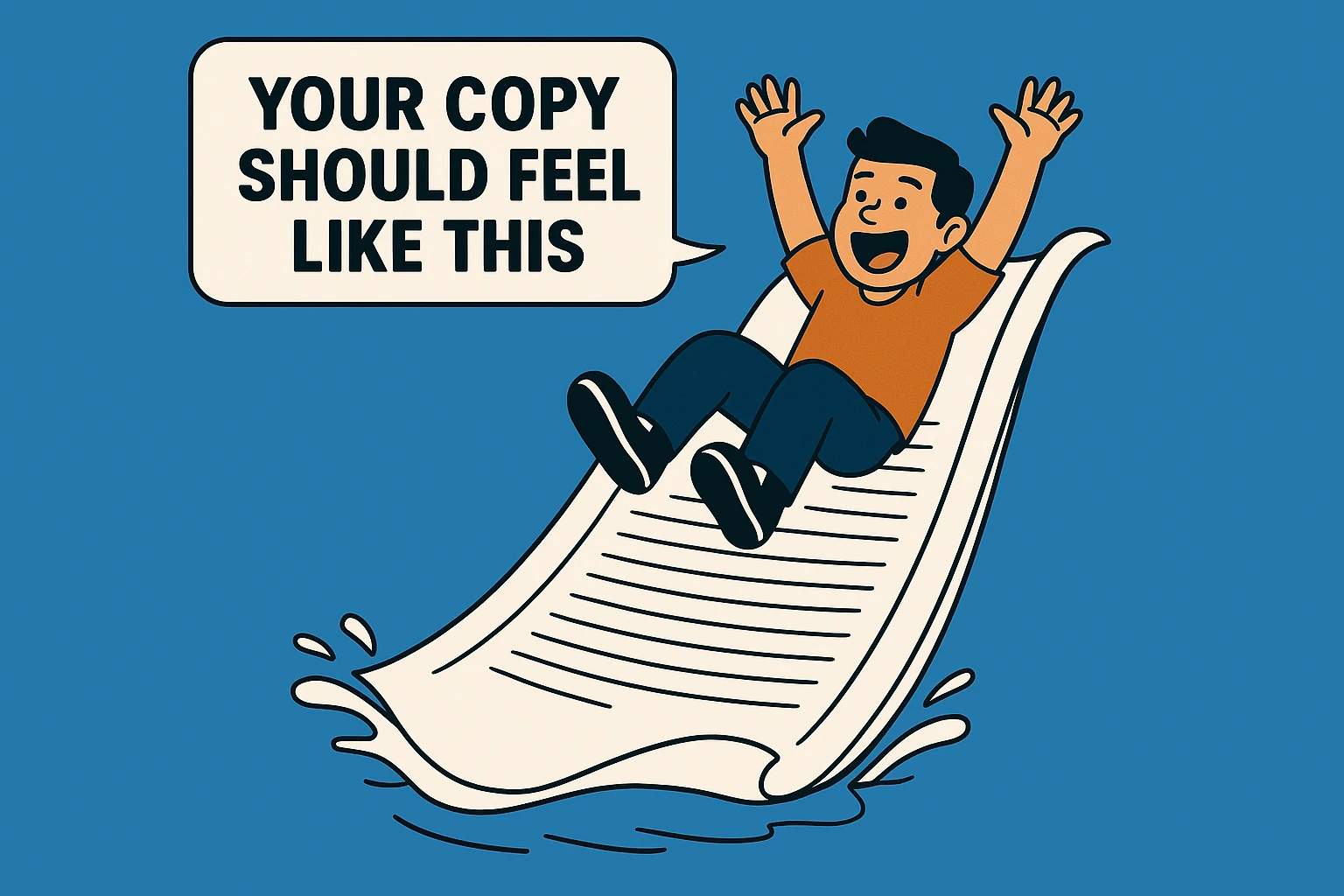
The slippery slide - the sensation of being carried forward, sentence by sentence, without resistance.
“Every element must be so compelling that you find yourself falling down a slippery slide, unable to stop until you reach the end.”
- Joseph Sugarman
Joseph Sugarman and the art of unstoppable copy
Joseph Sugarman wasn’t just a skilled copywriter. He was a master of direct response - and one of the most inventive ad minds of his time.
In the 1970s, he founded JS&A, a mail-order company that sold high-tech gadgets and consumer electronics directly to people’s homes.
But what really made JS&A successful wasn’t the inventory - it was the copy.
His long-form print ads didn’t read like marketing. They read like stories.
They opened with intrigue, built trust through narrative, and carried readers all the way to the offer - without friction, without fluff.
“Telling a story can effectively sell your product, create the environment or get the reader well into your copy as you create an emotional bonding with your prospect.”
- Joseph Sugarman
Sugarman had a gift for turning even the most unexpected products into irresistible offers.
Some of his most memorable ads weren’t just effective - they were audacious, original, and impossible to ignore.
Here are a few of the ads that made people stop and wonder, “Wait... is this for real?”
The $6 Million Mail Order Mansion
In 1987, Sugarman ran a full-page ad titled “Mail Order Mansion” attempting to sell a $6 million luxury home on a peninsula near Los Angeles.
The ad described the home’s stunning location, mentioned the neighbor’s even pricier house, and offered a videotape tour for $20.
The house didn’t sell. Neither did enough tapes to cover the ad costs.
But it made headlines, landed him on The David Letterman Show, and even caught the attention of the Disney estate, which asked if he’d do the same for Walt Disney’s old home.
He passed. One crazy real estate ad was enough.
Selling a $240,000 Airplane - with Humor
Sugarman once sold his Aerostar 601P plane using a single ad titled “Pet Plane.”
The copy told the story of why he was parting with the aircraft - and why his mechanic, who treated it like a beloved pet, wanted it to find a good home.
He even tossed in a joke about including a steer from his new farm, because “it’s hard to sell a plane without a little bull.”
The plane sold quickly. Full asking price. One ad.
A Spelling Contest to Sell a Gym Machine
Faced with the challenge of selling an expensive Nautilus Lower Back Machine, Sugarman didn’t drop the price - he made readers work for it.
The ad, “NAUTILUS SPELLING SALE,” was deliberately filled with misspelled words and bad grammar.
Readers got $10 off for every mistake they circled.
People spent hours poring over the ad, even if they had no intention of buying. The campaign worked - because it made the ad itself impossible to ignore.
A Holiday Gift... on the Space Shuttle
In 1983, JS&A ran an ad announcing it had officially petitioned NASA to become the first company to sell commercial seats on the Space Shuttle.
The pitch? A one-of-a-kind holiday surprise.
Ambitious. Absurd. Impossible to forget.
Sugarman understood something most marketers often overlook:
People don’t just buy products - they respond to curiosity, surprise, and emotion.
Whether he was selling sunglasses or a plane, his copy created momentum that carried readers straight through to the end.
One of his favorite examples came in the form of a complaint.
A woman - a scientist and regular reader of Scientific American - once wrote him a letter after seeing an ad for a thermostat.
She had no interest in thermostats. She rarely read ads at all. But somehow, she found herself reading every word.
“I wasted five minutes of my valuable time reading the entire thing,” she wrote.
“And I was so upset at the complete waste of my time that I wanted to write you and complain.”
Sugarman saw it for what it was: the highest compliment a copywriter could get.
Why this principle works
Sugarman’s slippery slide works because it mirrors how we naturally process information - one simple thought at a time, with just enough curiosity to keep going.
People don’t finish reading because they’re obsessed with thermostats or gym machines.
They finish because something pulled them forward.
You’ve probably experienced it without realizing.
An email lands in your inbox.
It starts: “I almost didn’t send this.”
Then: “But after what happened yesterday, I had to.”
Then: “It’s about something you didn’t see coming.”
A few lines in, and you’re already hooked.
Or maybe it’s a landing page.
The headline reads: “Don’t buy this yet.”
Next: “There’s something you need to see first.”
Then: “It takes 30 seconds. It could save you $300.”
You didn’t mean to scroll - it just happened.
Even a review can do it.
First line: “I thought it was a scam.”
Then: “But by day three, I changed my mind.”
Followed by: “Here’s what happened between.”
Now you’re in the story, whether you meant to be or not.
That’s how the slippery slide works.
You’re not being convinced - you’re being carried.
It doesn’t rely on hype. It relies on flow.
Short sentences. Clean rhythm. One idea per line.
No jargon. No friction. Just forward motion.
And in a world of shrinking attention spans, that kind of momentum isn’t optional - it’s the whole game.
How to create slippery-slide copy
There’s no exact formula for building copy that keeps people reading - but there are patterns that work.
Joseph Sugarman shared dozens of techniques for creating that smooth, forward motion he called the slippery slide.
Here are five of the most effective. They’re not the only ones - but they’re a solid place to start:
- Hook the Reader Immediately
Everything at the top of your copy - headline, subheadline, even the image or caption - has one job: get the first sentence read. If you lose them here, you’ve lost them for good. - Make Each Sentence Lead to the Next
One idea per sentence. Clear language. Natural rhythm. You’re not writing paragraphs. You’re building momentum. - Use Seeds of Curiosity
Small phrases like “Let me explain” or “Here’s where it gets good” signal something more is coming. They keep people moving with minimal effort. - Tell a Story
People want to know how it ends. Even short stories - a quote, a moment, a before-and-after - give your copy a reason to be read. - Keep It Simple and Clear
Clarity is momentum. Break up long sentences. Use plain words. Make it feel like a conversation, not a presentation.
These five techniques are just a slice of what Sugarman taught - but they’ll take you far.
And more importantly, they’ll help your reader go farther too.
From the first line… to the very last.
Write like someone’s still reading
The slippery slide isn’t just a technique - it’s a mindset.
Picture someone casually skimming - and suddenly, they’re still going.
Not because they planned to. But because the words pulled them in.
Because something in the rhythm, the story, or the voice made it a pleasure to read.
That’s the real challenge:
Grab attention - then earn it, all the way to the last line.
It’s not about being clever.
It’s about forward motion.
One clear sentence. Then the next. Then the next.
Keep it going - one line at a time.