What Most Marketers Miss: Market Sophistication
It’s not enough to know your audience’s pain. You need to know how many solutions they’ve already been pitched.
Ever notice how the louder the promise, the less people care?
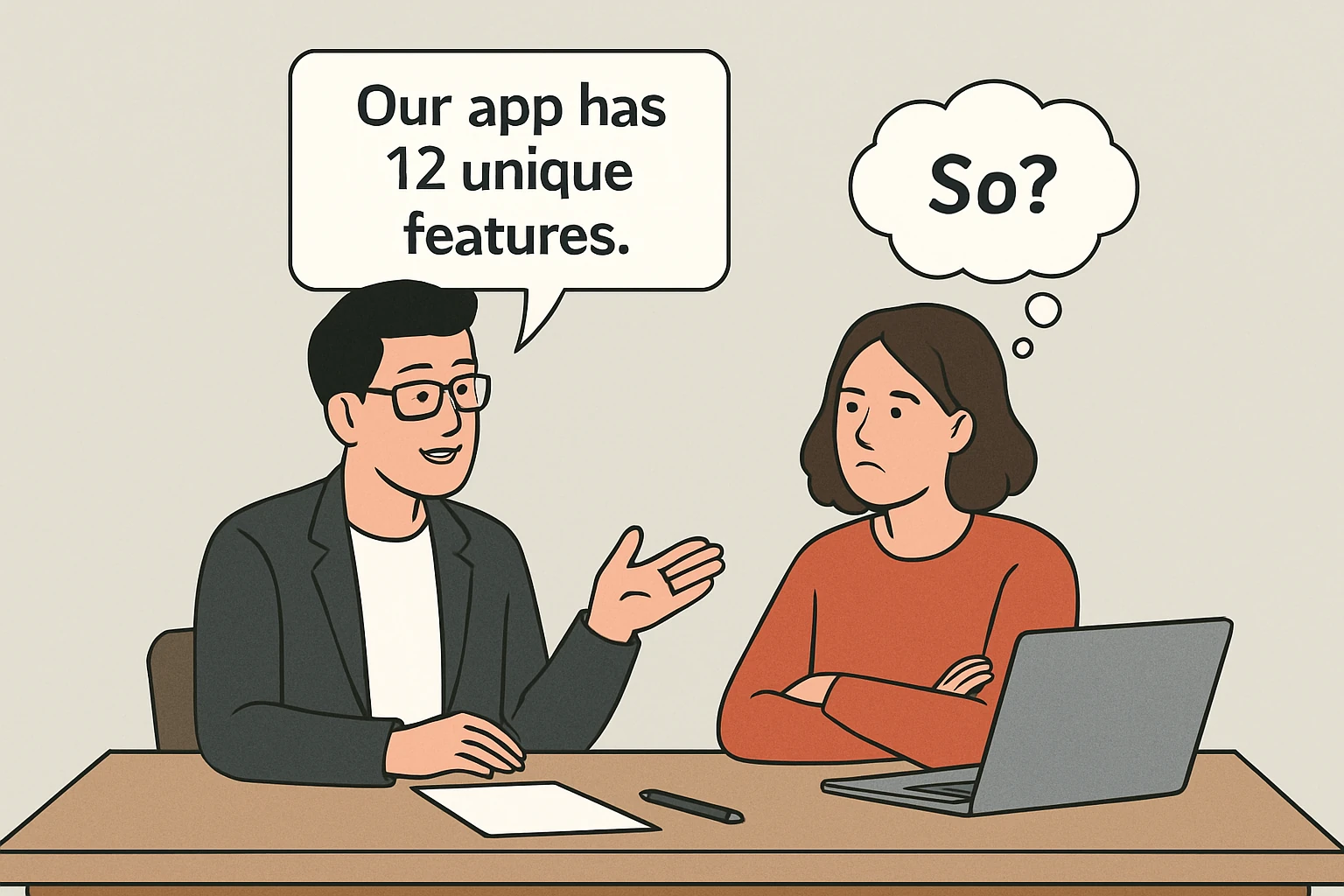
"Lose 30 pounds in 30 days."
"Double your income in a week."
"Skyrocket your traffic overnight."
These kinds of claims used to stop people in their tracks. Now they barely get a glance - or trigger an eye-roll.
What changed?
Not the product. Not the need.
The audience.
Your market has seen it all. They've clicked, bought, been disappointed - and now they've tuned out. The old tricks don't work anymore.
Your customers have moved on.
But most marketing hasn't.
It's not about your product. it's about what your audience has already heard.
Most business owners focus on what their product does - the benefits, the features, the results.
But your customer isn't hearing your message in a vacuum. They're hearing it in the context of everything they've seen before:
- Ads they've clicked
- Promises they've believed
- Products that overpromised and underdelivered
This idea comes from Eugene M. Schwartz, one of the most influential copywriters of the 20th century.
In his legendary book Breakthrough Advertising, Schwartz introduced the concept of market sophistication - a way to measure how familiar your audience already is with the promises in your industry.
It answers a critical question:
"How many times has your market heard a message like yours before?"
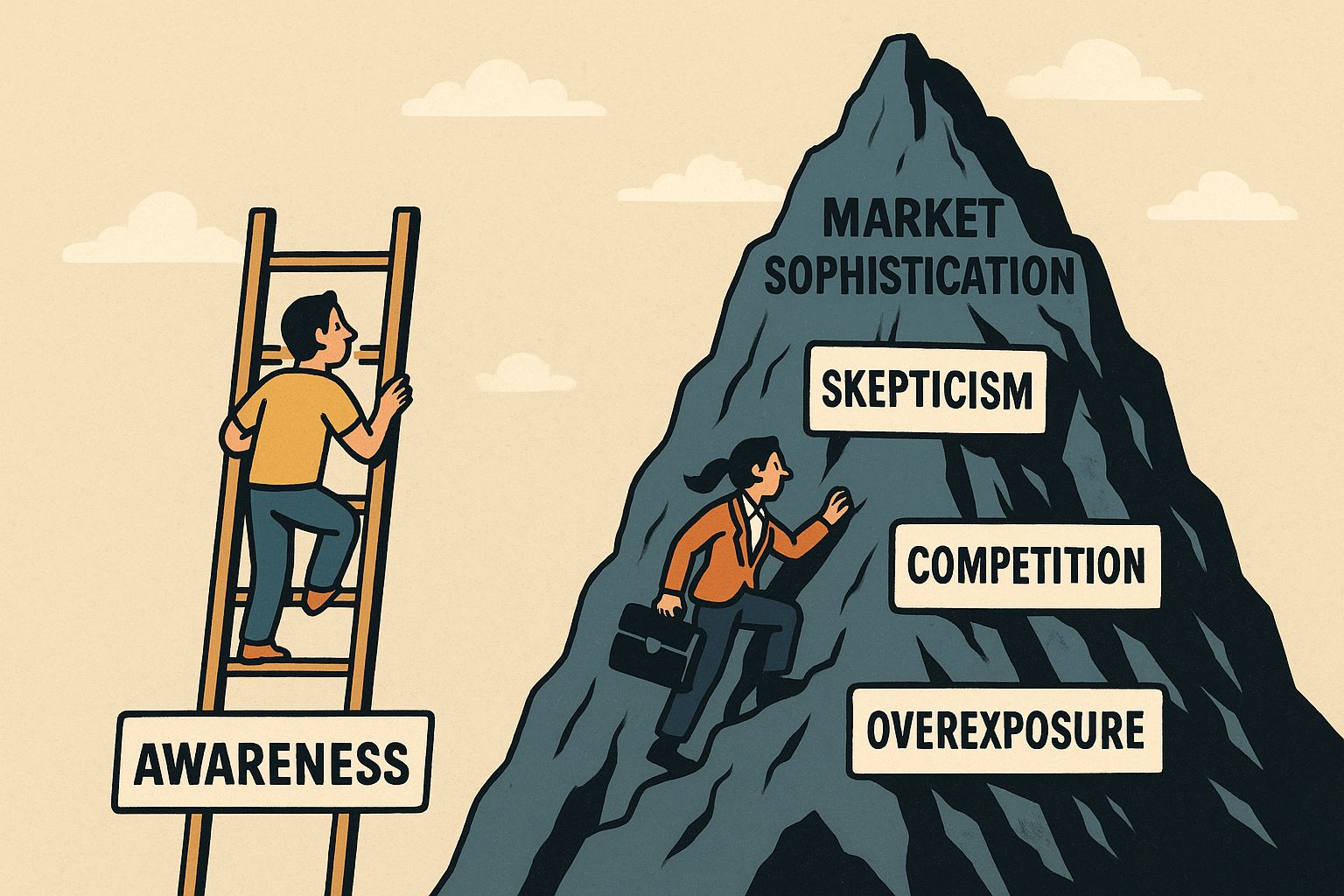
If you're the first one in your category to make a bold claim, people are open and curious. But if you're the fifth - or fiftieth - you've got an uphill battle. Skepticism kicks in. Promises blur together. Trust drops.
That's why some ads that worked five years ago fall flat today. It's not that the message got worse - your market just got smarter.
Understanding market sophistication helps you craft messages that cut through the noise - instead of adding to it.
In the next section, we'll walk through the 5 stages of market sophistication as defined by Schwartz, and show you how to match your message to each one.
How to spot where your market is right now
Every market goes through a natural evolution. At each stage, your audience becomes more aware, more skeptical, and harder to impress.
If your message doesn't evolve with them, it gets ignored - no matter how good your offer is.
Here's how the 5 stages work - and how to adjust your message for each one:
Stage 1: No One's Made the Promise Yet
Your product is brand new. Your market has never heard a solution like this before. They know they have a problem, but they've never seen an answer - until now.
What works:
A simple, bold promise. No frills. No fancy mechanism. Just show them the result they want.
Example:
"Lose Ugly Fat Now"
"Stop Hair Loss Today"
Your strategy:
Be direct. State the need or the result clearly. You're the first voice in the room - use that to your advantage.
Stage 2: The Promise Has Been Made
Now others are making similar claims. Your audience has heard it before - and they're starting to compare.
What works:
A bigger, stronger version of the original claim. Push the limits (without tipping into hype).
Example:
"Lose 30 Pounds in 30 Days - Or It's Free"
"I Lost 61 Pounds Without Feeling Hungry Once"
Your strategy:
Outbid the competition. Make your promise louder, faster, or more dramatic - but still believable.
Stage 3: People Have Tried - and Lost Trust
At this point, your audience has heard all the big promises and maybe even bought a few… with disappointing results.
Now they're skeptical.
What works:
You introduce something new: a mechanism. Instead of just saying what your product does, you explain how it works.
Example:
"Melts Fat Right Out of Your Body"
"The First Wonder Drug for Weight Loss"
Your strategy:
Shift the focus. Don't just promise results - explain why your product can finally deliver them. The mechanism makes the old promise feel fresh again.
Stage 4: The Mechanism Has Been Copied
Now everyone's using a mechanism - even if it's not real. The novelty has worn off.
What works:
Make your mechanism better. Faster, easier, safer, more complete. Or solve a bigger version of the problem.
Example:
"First No-Diet Wonder Drug"
"New Dual-Action Formula That Works While You Sleep"
Your strategy:
Level up your mechanism. Don't just explain how it works - explain how it works better than all the others.
Stage 5: Your Audience Doesn't Believe Anything Anymore
The market is completely saturated. The promises and mechanisms all sound the same. People are tired, jaded, and emotionally disconnected.
What works:
You stop selling a product - and start connecting with the person. The ad isn't about what the product does. It's about what the customer feels.
Example:
"Why Men Crack Under Pressure"
"Marlboro Country" (rugged imagery over claims)
Your strategy:
Forget the claim. Forget the mechanism. Speak to identity, emotion, values, or lifestyle. Help people see themselves in the message - not just the product.
The takeaway:
The more familiar your market becomes, the harder you have to work to make your message feel new, believable, and personal.
Trying to use a Stage 1 message in a Stage 4 market is like showing up to a job interview with a flipbook - it might have worked once, but now it's just noise.
Next, we'll look at why most small businesses get stuck - and how to fix it.
The trap of repeating what used to work
Most small business owners never realize that their market has changed. They keep running ads that used to work - sometimes word-for-word. And when results start dropping, they double down:
- Make the promise louder
- Add more benefits
- Throw in a guarantee
- Offer a bigger discount
But here's the hard truth: when the market shifts, more of the same just stops working.
If you're in a Stage 3 or Stage 4 market (and most are), your audience isn't looking for a louder claim - they're looking for a reason to believe it.
That's why Stage 2 messaging - the amplified promise - starts to fail. It feels recycled. Familiar. Even desperate.
At this point, what you say isn't as important as how you say it.
Your audience needs a fresh angle, a new mechanism, or a message that finally speaks to them, not just the product.
But here's the good news:
Most of your competitors are still stuck making the same exaggerated claims. If you shift your message to match your market's stage, you instantly stand out.
In the next section, we'll show you how to adjust your message for each stage - with real examples of what to say and what to avoid.
From "What it does" to "Why it works" to "Why it matters"
Once you understand which stage your market is in, your job is simple: match your message to their mindset.
Here's a breakdown of how to adjust your messaging at each stage - including examples of what works and what to avoid.
Stage 1 - Say What It Does. Period.
The audience: Fresh, unexposed, and hopeful.
Message style: Bold, direct, no need for explanation.
Say this:
"Erase wrinkles in 7 days."
Avoid this:
Overcomplicating it. No one's heard this before - don't bury the lead.
Stage 2 - Say It Louder, Sharper, or With Proof
The audience: Interested but starting to compare.
Message style: Push the limits. Use testimonials or specific results.
Say this:
"Lost 28 pounds in 30 days - and kept it off for a year."
Avoid this:
Vague claims like "Feel better fast." They won't cut through.
Stage 3 - Explain Why It Works
The audience: Skeptical. Burned by hype.
Message style: Introduce a new mechanism - the how.
Say this:
"Targets fat at the cellular level with our patented enzyme blend."
Avoid this:
Restating the same old promise. They've stopped believing it.
Stage 4 - Show How It Works Better
The audience: Mechanism-aware, comparing options.
Message style: Improve on what's out there. Be specific.
Say this:
"Works in 3 hours instead of 3 days - thanks to time-release capsules."
Avoid this:
Generic improvements like "Now even better!" (better how?)
Stage 5 - Make It Personal
The audience: Numb to promises. Trust is low.
Message style: Focus on identity, values, or emotion.
Say this:
"You've tried everything. You're not lazy - you've just been lied to."
Avoid this:
Any direct promise. They've heard them all. Make them feel seen, not sold.
Quick Tip:
Not sure what stage your market is in? Look at your competitors' ads. The louder and more desperate the claims, the further along the market likely is.
Up next: we'll look at some real-world examples that bring this all to life - and show how brands adapted their message as markets evolved.
Real-world examples: How 5 markets evolved through the stages
We've covered the theory - now let's see it in action.
These five examples show how real brands have shifted their messaging through each stage of market sophistication. Some entered as first movers. Others joined crowded markets. But the winners all adapted how they communicated - not just what they sold.
1. Apple iPhone: From Usability Breakthrough to Lifestyle Identity
Apple didn't invent the smartphone - or even the consumer smartphone.
Before the iPhone, devices like the Nokia N95, Windows Mobile phones, and even early HTC touchscreen devices offered web access, cameras, and apps. But the interfaces were clunky, stylus-based, and fragmented.
What Apple introduced in 2007 wasn't just new - it was radically easier to use.
-
Stage 1: Usability Breakthrough (2007–2008)
"Apple reinvents the phone."
The iPhone combined phone, media player, and internet communicator into one elegant device with a full touchscreen and intuitive UI. It reframed what a smartphone could be for everyday users. -
Stage 2: Enhanced Claims (2009–2011)
"Twice as fast. Half the price."
With the iPhone 3G and 3GS, Apple began outbidding competitors on speed, affordability, and access to the App Store - building on the original promise with measurable improvements. -
Stage 3: New Mechanism (2012–2015)
"The most powerful chip ever in a smartphone."
As the market matured, Apple shifted focus to internal innovations - A-series chips, Retina displays, and camera systems. The message wasn't just what the iPhone did, but how it delivered that experience. -
Stage 4: Mechanism Elaboration (2016–2019)
"Dual cameras. Depth Control. A10 Fusion chip."
With competitors catching up, Apple emphasized technical superiority with layered, detailed messaging - showing not just innovation, but refinement. -
Stage 5: Identity & Emotion (2020–Present)
"Privacy. That's iPhone."
Apple now markets the iPhone as part of your identity - a reflection of your values and lifestyle. It's no longer about the specs. It's about you.
2. Fitness Trackers: From Step Counters to Wellness Companions
Fitness trackers began with a single promise: count your steps. Now, they help you optimize your entire life.
-
Stage 1: Basic Promise
"Track your steps."
Fitbit's early messaging was clear and direct, introducing a simple benefit to an unsophisticated market. -
Stage 2: Enhanced Claims
"Track calories, distance, and active minutes."
As brands like Jawbone and Nike+ entered, promises expanded to full-day health tracking. -
Stage 3: New Mechanism
"PurePulse Heart Rate. SmartTrack."
Fitbit emphasized new tech - like continuous heart-rate monitoring and auto-exercise detection - to stand out. -
Stage 4: Mechanism Elaboration
"REM sleep cycles. VO2 max. Recovery advisor."
With Apple Watch and Garmin in the game, the focus shifted to detailed biometrics and athletic insights. - Stage 5: Identity & Emotion
"Know yourself. Live better." (Whoop)
"Not a fitness tracker - a wellness companion." (Oura)
These devices now market lifestyle and identity, not just features.
3. Bottled Water: From Hydration to Personal Statement
Even water has gone through all five stages of sophistication.
-
Stage 1: Basic Need
"Clean, pure drinking water."
Early bottled water brands sold convenience and trust. -
Stage 2: Enhanced Claims
"Bottled at the source. Natural minerals."
Brands like Poland Spring and Dasani emphasized purity and origin. -
Stage 3: New Mechanism
"Electrolyte-enhanced. Volcanic filtration."
SmartWater and Fiji differentiated on how their water was processed or sourced. -
Stage 4: Mechanism Elaboration
"Alkaline 9.5pH. Reverse osmosis + electrolytes."
The focus shifted to increasingly niche scientific processes. -
Stage 5: Identity & Emotion
"JUST Water: Better for everyone."
"Liquid Death: Murder your thirst."
Water is now branded around values - sustainability, humor, rebellion - more than hydration itself.
4. Mattresses: From Sleep Product to Self-Improvement Tool
From showroom staple to health essential, mattress messaging has transformed.
-
Stage 1: Basic Promise
"A better night's sleep."
Traditional mattress brands offered comfort and rest, nothing more. -
Stage 2: Enhanced Claims
"Reinforced support with Posturepedic Technology."
As competition increased, claims became more specific and technical. -
Stage 3: New Mechanism
"Engineered foam layers for cool, supportive sleep." (Casper)
Direct-to-consumer brands introduced proprietary materials and online convenience. -
Stage 4: Mechanism Elaboration
"Zoned support. Patented GelFlex Grid." (Purple, Leesa)
Companies competed on sleep science and design innovation. -
Stage 5: Identity & Emotion
"Your best self starts with sleep." (Saatva)
"Mattress shopping, finally figured out." (Helix)
Now, it's not about the mattress - it's about wellness, self-care, and lifestyle.
5. Tesla: From Disruption to Belief System
Tesla didn't just launch a car - it launched a movement.
-
Stage 1: Revolutionary Product
"The first high-performance electric sports car."
The Tesla Roadster changed the narrative around electric vehicles. -
Stage 2: Enhanced Claims
"The safest, fastest sedan ever."
The Model S didn't just match gas cars - it outperformed them. -
Stage 3: New Mechanism
"Autopilot. Over-the-air software updates."
Tesla emphasized its tech advantage - features no traditional carmaker could match. -
Stage 4: Mechanism Elaboration
"Full Self-Driving. Heat pump efficiency."
Messaging dove deeper into the technical layer to keep Tesla ahead in a now-crowded EV market. -
Stage 5: Identity & Emotion
"Accelerating the world's transition to sustainable energy."
Tesla markets a mission - owning one says you believe in the future.
Conclusion: How to use this in your business today
Most small businesses don't fail because their product is bad - they fail because their message is out of sync with their market.
You've now seen how markets evolve through five stages. Each stage demands a different message:
- In early stages, be bold and direct.
- In middle stages, explain your mechanism.
- In later stages, speak to identity and emotion.
So what do you do now?
Here's a simple checklist to apply this:
-
Look at your competitors' ads.
What kind of promises are they making? Are they all saying the same thing? - Ask yourself what your customer has already heard - and likely stopped believing.
-
Pick your stage.
Use the examples in this post to spot where your market is in the cycle. -
Adjust your message.
Simplify, explain the mechanism, or shift to identity - depending on the stage.
You don't need to overhaul your business. You just need to tune your message to where your market really is - not where it used to be.
That's how you cut through the noise. And that's how you sell smarter in a saturated world.