Clyde Bedell’s Copywriting Trick: The Three-Benefit Formula
A simple three-step structure from a 1940s ad man that still delivers clear, persuasive copy today.
If you've spent any time studying copywriting, you've probably seen more formulas than a high school chemistry textbook. AIDA, PAS, FAB, the 4 Ps, the 4 Cs, the 3 Rs... sometimes it feels like the whole alphabet is trying to sell you something.
But Clyde Bedell’s “Three-benefit” formula deserves a spot in the rotation. First published in How to Write Advertising That Sells in 1940 and revised in 1952, it’s a deceptively simple structure that still holds up today. It shows you exactly how to present benefits in a way that grabs attention, builds desire, and moves people to act.
The formula at a glance
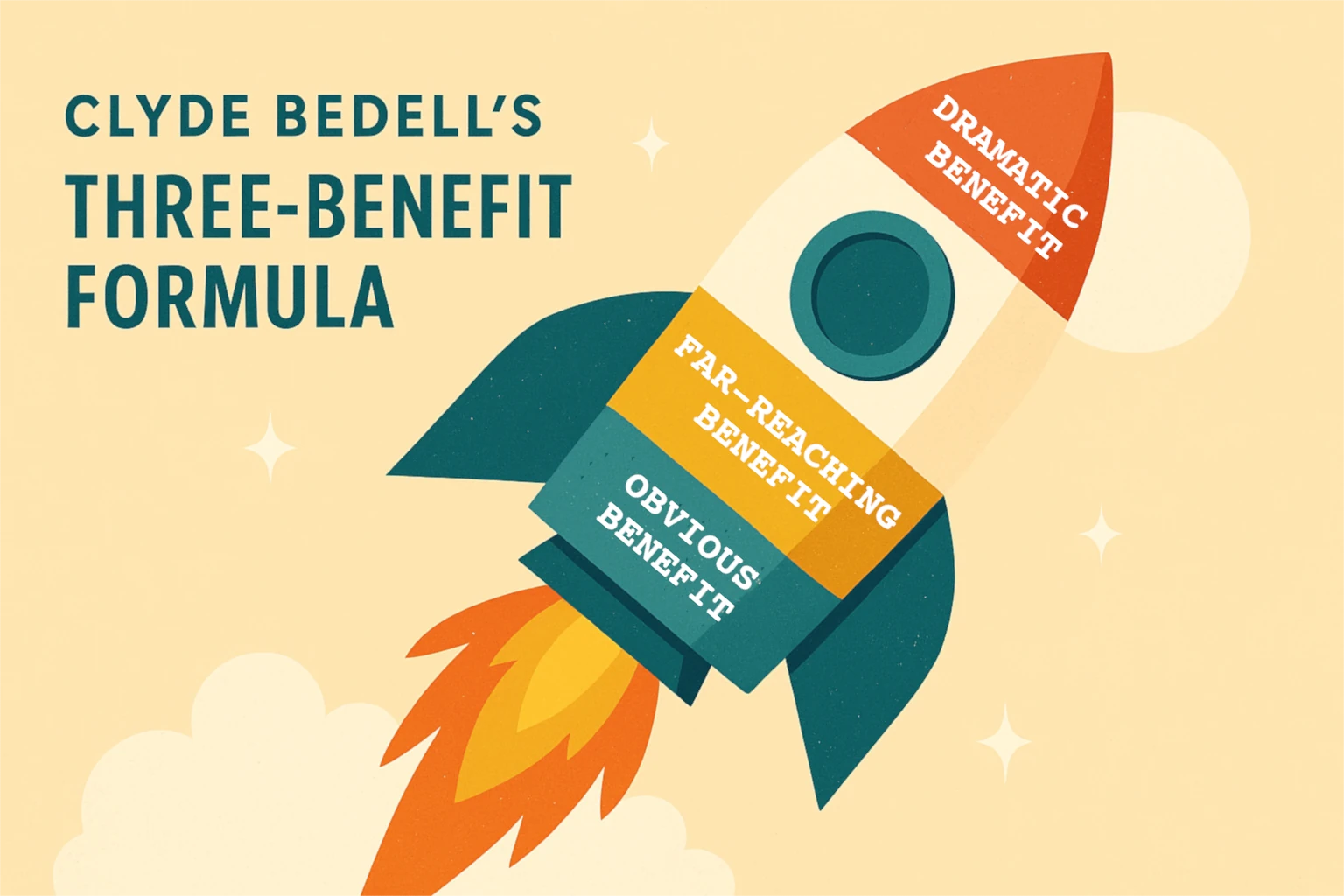
This three-part structure is exactly what it sounds like: a way to organize your message around three carefully chosen benefits, delivered in a specific order to maximize impact.
- Start with the most obvious benefit. This is the one your reader will recognize immediately. It should be easy to grasp and hard to disagree with.
- Follow with the most far-reaching and long-lasting benefit. This is the deeper value, the lasting reward. It’s not just what your product does now, but what it will keep doing.
- Close with the most dramatic or surprising benefit. This is your finale - something emotionally charged or especially enticing.
This sequence isn’t just logical - it’s psychological. You're starting with agreement, building interest, and ending with emotional lift.
Why it works
1. It matches how people read and decide
Most readers skim. This structure starts with something easy to agree with, adds meaningful value, and finishes with a reason to act.
2. It complements other classic frameworks
It works within AIDA and PAS, strengthening your message during the most persuasive moments.
3. It builds emotional momentum
The formula creates rhythm and pacing - a persuasive build-up from basic appeal to strong emotional incentive.
Real-world examples
Here’s a classic example from Bedell himself, pitching a fountain pen:
“Here is a fountain pen guaranteed not to leak, but on the other hand, to flow smoothly. It has a point and sac - weak spots on most pens - which assure you of perfect writing service for a long time. This month, we will stamp your name on any one you purchase - in 12 karat gold - free of charge.”
- Obvious benefit: It won’t leak and writes smoothly.
- Far-reaching benefit: It’s built to last, even in the parts that usually fail.
- Dramatic benefit: Your name, in gold, engraved for free this month only.
Now let’s look at modern versions:
Running Shoes
“These are lightweight, cushioned running shoes built for comfort on everyday runs. They’re designed to support your feet over hundreds of miles, with durable outsoles and responsive midsoles that hold up over time. And this week only, you’ll get a second pair at 30% off - perfect for race day or rotating through your training.”
- Obvious: Comfort and lightness.
- Far-reaching: Long-term durability and performance.
- Dramatic: Limited-time offer on a second pair.
Electric Toothbrush
“This brush gives you a deep clean with sonic vibrations that remove plaque better than manual brushing. It’s built with a smart timer and long-lasting battery, so your brushing routine stays consistent even on the go. And right now, it comes with three replacement heads - free.”
- Obvious: Better daily cleaning.
- Far-reaching: Consistent, easy routine with helpful features.
- Dramatic: Free bonus items that add real value.
Online Course (Graphic Design)
“Learn how to design like a pro with step-by-step video lessons, no prior experience needed. You’ll build a portfolio as you go - one you can actually use to land freelance clients or a full-time job. Enroll today and you’ll get a free bonus module on branding worth $99.”
- Obvious: Easy, beginner-friendly lessons.
- Far-reaching: A real portfolio with career value.
- Dramatic: A free $99 bonus - limited-time offer.
How to apply it in your own writing
As you’ve seen in the examples above, this three-step sequence works across all kinds of products. Here’s how to use it yourself:
- List out all the benefits: Focus on outcomes, not just features. Ask what matters most to the reader.
- Assign each benefit to a role: What’s obvious? What’s lasting? What’s dramatic?
- Phrase them clearly and specifically: Use direct, vivid language. Avoid fluff.
- Put it all together: Structure your copy in order: obvious, far-reaching, dramatic. That’s your framework.
Common pitfalls to avoid
- Making all three benefits sound the same: Each one should add something new. Don’t repeat the same idea three ways.
- Confusing features with benefits: Translate specs into value. Show what it means for the user.
- Burying the drama: Your final benefit should leave an impression. Don’t end flat.
- Forcing the formula: If it doesn’t fit, don’t force it. Use it as a guide, not a rule.
Conclusion
There’s no shortage of frameworks in copywriting, but Bedell’s method earns its place because it helps you think like a buyer, not just a writer.
It pushes you to lead with clarity, anchor your message in long-term value, and finish with something that actually nudges action. That’s a solid foundation for any persuasive message - whether you’re selling shoes, software, or an idea.
If your copy ever feels flat or unfocused, try stepping back and asking:
- What’s the benefit they’ll notice right away?
- What’s the one they’ll appreciate over time?
- And what’s the one they didn’t see coming?
Start there - and your writing will already be ahead of the curve.